How Much Rooftop Space Do You Need for Solar?
This article explains what makes rooftop space suitable for solar, how capacity is calculated, and why proper assessment is key to getting the best results.
Yash Jakhete
Co-Founder
Another common question before installing solar is:
“Do I even have enough roof space for solar to make sense?”
The answer is often more encouraging than expected — but it depends on how the space is evaluated.
How rooftop space affects solar capacity
In simple terms:
More usable rooftop space allows for higher solar capacity
Higher capacity means more electricity generation and higher savings
However, not all roof area is usable.
What counts as usable rooftop space?
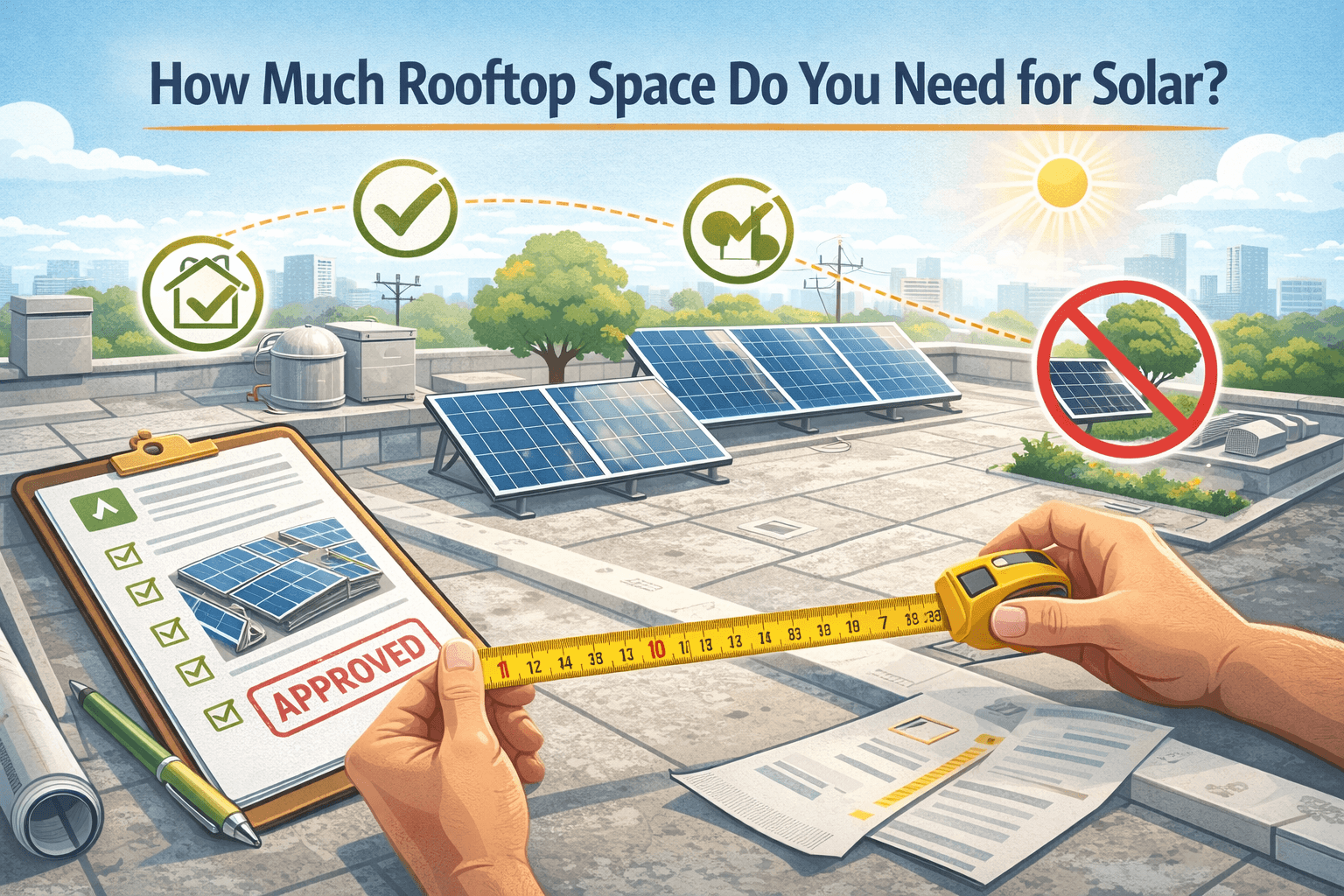
When evaluating a roof, these factors matter:
1. Roof orientation and tilt
South-facing or optimally tilted roofs receive better sunlight.
2. Shading
Nearby buildings, trees, water tanks, and parapet walls can reduce usable area.
3. Structural strength
The roof must safely support the solar structure and panels.
4. Accessibility and safety
Adequate access is needed for installation and maintenance.
This is why a site visit is critical — paper calculations alone are not enough.
How much space is typically needed?
As a broad guideline:
Smaller systems need only a portion of the roof
Larger systems require more continuous, shadow-free space
But the exact requirement varies based on:
Panel efficiency
Mounting structure
Layout design
A well-designed system can often fit more capacity into the same space compared to a poorly planned one.
What if roof space is limited?
Limited space does not mean solar isn’t viable.
Even a smaller system can:
Offset the most expensive part of your electricity usage
Deliver meaningful monthly savings
Be expanded later if more space becomes available
Solar works best when sized realistically to available conditions.
Why professional assessment matters
Many people underestimate how much difference good design makes.
A professional assessment looks at:
Current and future electricity needs
Practical installation constraints
Long-term expansion possibilities
This ensures you don’t:
Overspend on unnecessary capacity
Underinstall and miss potential savings
How Solarising approaches rooftop evaluation
At Solarising, rooftop assessment is not rushed.
We evaluate:
Usable roof area
Structural and safety considerations
Shading patterns
Optimal layout for long-term performance
This allows us to recommend a system that is practical, safe, and financially sensible.
The right takeaway
You don’t need a perfect or massive roof to benefit from solar.
You need a realistic assessment and smart system design.
When rooftop space is evaluated properly, solar can be adapted to work for a wide range of buildings — industrial, commercial, and residential.
Solarising helps you understand what’s possible on your roof, without assumptions or pressure.
Share on social media